

Introduction
The Commuter Dilemma: The Nightmare of the Daily American Ride
If you live in a major US metro area like New York, Los Angeles, Chicago, or San Francisco, the term “Rush Hour” is undoubtedly the most dreaded part of your day. Picture yourself bumper-to-bumper, trapped in highway gridlock, helplessly watching the clock tick closer to clock-in time. In many American downtown cores, daily rates at parking garages can easily cost you $25 to $75. According to AAA’s “Your Driving Costs” study, the average annual cost to own and operate a new vehicle in the United States hovers around $11,577. Compounding expenses like depreciation, insurance, fuel, maintenance, and those steep parking fees continue to make car commuting financially draining for many Americans.
Even if you opt for public transit like the subway, you still run into the infamous “Last-Mile Commute”—that exhausting walk from the station platform all the way to your office door. That is exactly why a commuter scooter for adults (electric scooter) is becoming the ultimate liberation. It allows Americans to take full control of their daily routes, save thousands of dollars a year, and turn a soul-crushing commute into an exhilarating ride.

Where This Fits In: The Commuter Scooter’s Place in the Ecovura Lineup
The electric vehicle landscape is massive and can feel completely overwhelming. To make your choice easier, we at Ecovura have built a classification system dividing electric scooters into 4 distinct categories based on intended use and real-world performance. If you are not quite sure which category fits you best, feel free to check out our comprehensive guide: How to Choose an Electric Scooter.
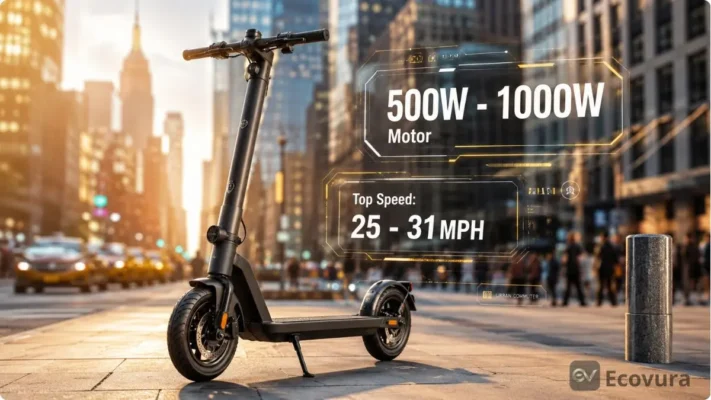
In our lineup, the Commuter Scooter category represents Category 2—featuring motor power ranging from 500W to 1000W and top speeds of roughly 25 to 31 MPH, depending on the model. Beside Commuter Scooters, our system also includes: Portable Scooters, Off-Road Scooters, and Performance Scooters.
The Sweet Spot: The “Golden Mean” for Urban Living
What makes a Commuter Scooter the absolute go-to choice for daily riders is its perfect trinity of balance: enough power for daily grinds, enough battery to go the distance, and enough portability to carry when needed.
With a power output between 500W and 1000W, these electric scooters pack plenty of punch to tackle urban streets, bridge inclines, and steep parking garage ramps without feeling sluggish or losing torque. Pair that with a typical real-world range of 25 to 40 miles per charge, and you can easily cover your work commute, grocery runs, and daily errands without a shred of range anxiety.
More importantly, a Commuter Scooter retains the nimble, grab-and-go nature required for modern city life. Weighing around 40 to 55 lbs (18–25 kg) and featuring quick-folding mechanisms, you can effortlessly bring your electric scooter into elevators, offices, or apartments, or toss it right into your car trunk when needed.
That is the true “sweet spot” of this segment: an electric scooter powerful enough for the journey, with enough battery for the whole day, yet compact enough to be your ultimate flexible urban companion.
Who is a Commuter Scooter For?
The Target Riders: Do You See Yourself in These Three Profiles?
This urban electric scooter segment wasn’t built for adrenaline-seeking racers; it was engineered to fit the practical lifestyle of three typical American city groups:
• 9-to-5 Office Workers: Forget about the stress of gridlock or standing endlessly waiting for public buses. For the American corporate crowd, a commuter scooter for adults is the ultimate ticket to always clocking in on time. Unlike a traditional bicycle, an electric scooter lets you glide effortlessly through city blocks without breaking a sweat. It keeps your dress shirts and business suits crisp, clean, and fresh the moment you step into the boardroom.
• College Students: University campuses across the US are notoriously massive, with dozens of buildings scattered miles apart. Walking between back-to-back classes can feel like a race against the clock. An electric scooter with an ideal top speed of an electric scooter 20 MPH or more helps students zip between lecture halls, libraries, and dorms—saving precious time and eliminating the anxiety of being late to class.
• The Last-Mile Commuters: These are the suburban residents who take the commuter rail or bus into the downtown core for work. Their pain point? The distance from the transit station to their office is just a bit too far to walk, but way too short to justify booking an Uber. An electric scooter is the perfect missing puzzle piece: you ride it from your house to the station, fold it up to hop on the train, and then unfold it to cruise straight from the platform to your office front door.
The Ideal Terrain: The Environments Where This Scooter Shines
Manufacturers have fully optimized this segment for American Urban Streets. We are talking about relatively smooth asphalt, clearly marked city bike lanes, or spacious paved pathways.
The suspension systems and tires in this category are designed to soak up speed bumps, manhole covers, and minor cracks in concrete roads. Furthermore, these electric scooters pack just the right amount of torque to climb moderate inclines on hilly city streets without any noticeable drop in performance.
The Perfect Distance: The Sweet Spot Mileage for Your Daily Routine
The ideal daily travel distance for this type of electric scooter is 5 to 15 miles (roughly 8 to 24 km). This falls right into the average daily mileage bracket for most city workers and students. Within this range, the scooter operates at peak efficiency, guaranteeing you a fast, safe, and incredibly budget-friendly trip compared to any other mode of transportation.
The Battleground: Where Brands Compete
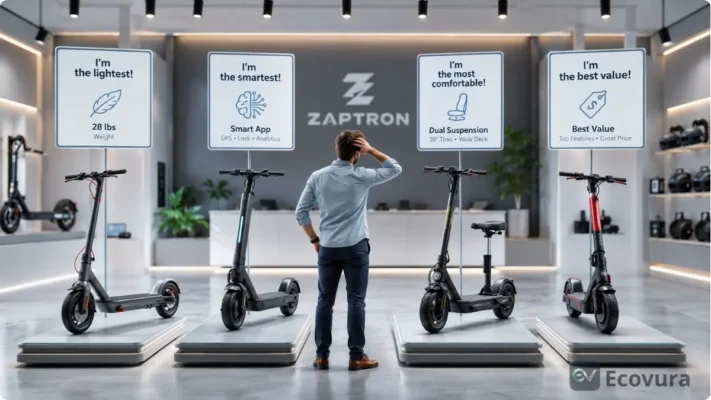
To fully satisfy the needs of urban riders, manufacturers today focus heavy optimization on three core pillars: speed/power, battery capacity, and portability. However, now that these baseline standards have been established, the 500W to 1000W commuter segment is seeing brands take vastly different strategic directions. These distinct selling points are exactly what American consumers look for when comparing models to find the perfect match for their lifestyle:
• Premium Materials (Material Innovation): Moving away from heavy, traditional steel frames, most of the market has shifted to aircraft-grade aluminum alloy to optimize durability and shed dead weight. Furthermore, a few brands carve out a niche by utilizing ultra-premium materials like carbon fiber or super-lightweight magnesium alloy. This design path yields a commuter scooter for adults with a dream curb weight—ideal for constant lifting and moving without sacrificing structural chassis rigidity.
• Smart Tech & Dashboards (Feature Integration): Tech integration has become a major competitive battleground as electric scooters become deeply digitized. Riders now expect high-contrast, crisp LED displays that remain readable in direct sunlight, secure NFC card key access, and built-in GPS tracking for enhanced anti-theft security. Developing robust Bluetooth-connected mobile apps to customize ride modes or monitor battery health is another way manufacturers elevate the user experience. If you want to see a prime example of this technology in action, check out our comprehensive NIU scooters buyer’s guide to explore how their smart connected app ecosystem sets the industry standard..
• Portability Innovation (Optimized Folding Solutions): Maximizing storage efficiency in tight office cubicles or car trunks is a daily reality for American commuters. While a quick-folding mechanism with a safety latch has become the baseline industry standard, some innovative brands take it a step further by engineering folding handlebars that collapse flush against the stem. This small detail drastically shrinks the overall footprint, allowing the electric scooter to slide easily into tight spaces like personal under-desk lockers.
• Ride Comfort (Dampening Solutions): Because road quality varies wildly from city to city, manufacturers typically offer two distinct engineering approaches to tackle road vibration. One camp focuses on budget friendliness, pairing traditional spring suspension with standard inner-tube tires. The other camp prioritizes a premium ride feel, deploying hydraulic forks combined with large 10-inch, puncture-resistant tubeless pneumatic tires. This high-end setup is the secret to gliding smoothly over aggressive speed bumps and city manhole covers.
• Price vs. Value (The Cost-to-Benefit Balance): In the US market, the commuter electric scooter segment typically ranges from $300 to $1,000. This is a highly attractive price bracket for consumers looking to offset gas money or long-term transit passes. In reality, there is no single “winner” in this price range; the competitive edge belongs to manufacturers who masterfully balance tech-forward features with a price point that makes sense for the average commuter’s wallet.
A Real-World Scooter Selection Framework
Deciphering the Spec Sheet: Meanings and Trade-offs
When browsing any electric scooter, manufacturers will throw a mile-long spec sheet at you. However, every single specification has two sides and comes with a built-in “trade-off”:
• Top Speed & Motor Power: This indicates how much muscle the electric scooter has and the maximum velocity it can hit. The higher the wattage, the punchier the acceleration and the better it sustains top-end speeds.
o The Trade-off: Riding fast doesn’t just drain your battery quicker; it demands a comprehensive system-wide upgrade. To keep you safe at high speeds, manufacturers must equip the scooter with a larger battery pack, beefier tires with better traction, a reinforced chassis, and high-stopping-power brakes. The inevitable result? The electric scooter becomes significantly heavier, and the rider must maintain laser-focus on the road.
• Battery Capacity & Range: Battery capacity (measured in Watt-hours or Wh) dictates how far your electric scooter can travel on a single full charge.
o The Trade-off: A massive battery eliminates range anxiety and lets you go the distance. On the flip side, a giant battery pack substantially blows up the overall weight and footprint of the scooter. Naturally, an electric scooter packed with massive range will command a premium price over a smaller-capacity counterpart.
• Weight & Portability: This reflects how nimble, easy to lift, or simple to store your electric scooter is.
o The Upside/Downside: Ultra-lightweight and compact folding electric scooters make carrying them up subway stairs or tossing them into a car trunk a breeze, but they feel less planted at high speeds. Conversely, a heavy scooter is a chore to lift, but it delivers a rock-solid chassis, stable handling, and zero wobble when cruising fast.
• Tire Size & Hill Grade: Larger tires (10-inch and up) roll over obstacles and road debris with ease; the hill grade percentage (%) indicates the scooter’s ability to conquer bridges and underground parking ramps.
o The Upside/Downside: Larger tires paired with dedicated suspension guarantee a plush ride that saves your wrists and spine, but they add a bit of weight to the overall build.
• Smart App Control: Connects via Bluetooth or NFC to lock the scooter, track its location, or customize riding profiles. While this is a highly convenient tech feature that bolsters anti-theft security, it does push the retail price slightly higher than a purely mechanical setup.
💡 Wondering about the rest? Beyond these specs, an electric scooter involves plenty of other factors: build materials, styling, physical dimensions, safety certifications (like UL certifications), lighting, and accessories… So, what is the single most critical metric to anchor your decision? The answer is right below in Section B.
Personalizing Your Choice: The Practical Decision Framework
There is no single “best” electric scooter; there is only the scooter that perfectly fits your specific daily routine. In the current commuter segment, motor power is the fastest indicator to gauge other specs like battery size, chassis dimensions, braking systems, and overall performance. To avoid getting lost in marketing clutter, we recommend using your total daily mileage as the baseline for choosing your motor power:
Step 1: Establish Your Baseline Power by Daily Mileage
| Daily Distance | Recommended Power |
|---|---|
| Under 10 miles | 500W – 700W |
| 10–20 miles | 700W – 900W |
| 20–30 miles | 900W – 1000W |
| Over 30 miles | Consider other options |
• If your total route is under 10 miles/day: The sweet spot is 500W to 700W. This power range is ideal for short commutes, keeping the electric scooter relatively lightweight, easy to carry, and highly agile.
• If your total route is 10 to 20 miles/day: You should prioritize the 700W to 900W mid-range bracket. These mid-tier motors offer the sustained stamina needed for longer hauls and hold stable speeds effortlessly.
• If your total route is 20 to 30 miles/day: Look exclusively at electric scooters rocking 900W to 1000W motors. In most commuter models, higher wattage brings along a larger battery pack and a sturdier frame, giving you the peace of mind to finish your commute without running on empty.
• If your total route is over 30 miles/day: Urban electric scooters start to show their limitations. For long-distance hauls like this, you should look into alternative transit options.
A Quick Note on Road Conditions: The distance-to-power brackets above assume standard, flat city roads. If your actual commute involves a minefield of potholes, aggressive speed bumps, or frequent steep inclines (like bridge ramps or underground garages), you should proactively step up one power tier to keep your motor from straining.
📌 Real-World Takeaway: This advice anchors on the most defining factor: power. While you can always opt for a higher wattage to give yourself some extra performance headroom, you should never drop below our recommended thresholds if you want a reliable, long-term ownership experience.

Step 2: Cross-Reference and Check the Community
Once you’ve locked in your target power bracket, pick two or three electric scooters in that category (either from the same manufacturer or competing brands) and put them head-to-head.
To get the most authentic picture, look past the manufacturer’s spec sheets and check out independent reviews—especially user-driven communities like dedicated subreddits on Reddit. To save you the legwork, we at Ecovura constantly curate deep-dive roundups from trusted online forums and conduct direct owner interviews, giving you unbiased, real-world feedback on specific models.
Step 3: Hunt for Deals
Once you have pinned down your ideal electric scooter, the final step is to scout for promotional offers, discount codes, or bundled accessory packages right here at Ecovura to get the best return on your initial investment.
Conclusion: Ready to Upgrade Your Daily Commute?
A true urban commuter electric scooter doesn’t need to be the most expensive model on the market or boast face-melting top speeds. Instead, it is the one that smartest and most completely solves your actual, day-to-day transit puzzle. Once you understand that every technical specification is engineered and synchronized around the “heart” of the vehicle—its motor power—you will never get lost in flashy manufacturer marketing again. Start by mapping out the exact mileage of your daily route, assessing the road quality you encounter, and applying the 3-step framework we shared to narrow down your shortlist.
Don’t let grueling rush hours, sky-high downtown parking fees, or soul-crushing traffic gridlock drain your positive energy day after day. Take the handlebars of your commute and turn it into a liberating, budget-friendly, and exhilarating journey.
Next Steps – Where Do You Go From Here?
• Read Our Deep-Dive Brand Reviews: Check out our comprehensive brand-by-brand guides and real-world testing reports to confidently narrow down your top choices.
• Ask an Expert: If you are still torn between two specific models or have a unique commuting scenario (like handling intense hills or multi-modal transit switching), feel free to drop a comment below or reach out to the Ecovura advisory team. We are here to give you personalized, expert advice completely free of charge.
Frequently Asked Questions
What is a Commuter Scooter?
A commuter scooter is a personal electric vehicle explicitly engineered for daily urban transit, typically balancing a 500W to 1000W motor and top speeds of 25 to 31 MPH to conquer city traffic, hills, and long distances while maintaining a portable, foldable design for real-world practicality.
How do I choose the commuter electric scooter that is right for me?
Choosing the perfect commuter scooter comes down to a smart, structured approach:
First, calculate your total daily mileage to select the appropriate motor power and battery range for your route. Once you’ve locked in those core specs, compare other critical secondary features across your shortlisted models—such as frame materials (aluminum vs. carbon fiber), suspension types, tire sizes, and smart tech integration. Next, deep dive into community reviews, expert forums, and real user feedback to evaluate real-world durability. Finally, before pulling the trigger, always scout for active discount codes or seasonal sales to maximize your value and save on your upfront investment.
Are the manufacturer-stated specifications for electric scooters actually accurate?
Manufacturer specifications are based on controlled factory and laboratory tests, which naturally differ from real-world riding conditions, leading to variations in actual performance. However, these provided specs are still highly valuable as a baseline reference for selecting your product. Before making a purchase, you should actively cross-reference them with real user reviews, paying close attention to their specific riding conditions and how they compare to your own daily route.