
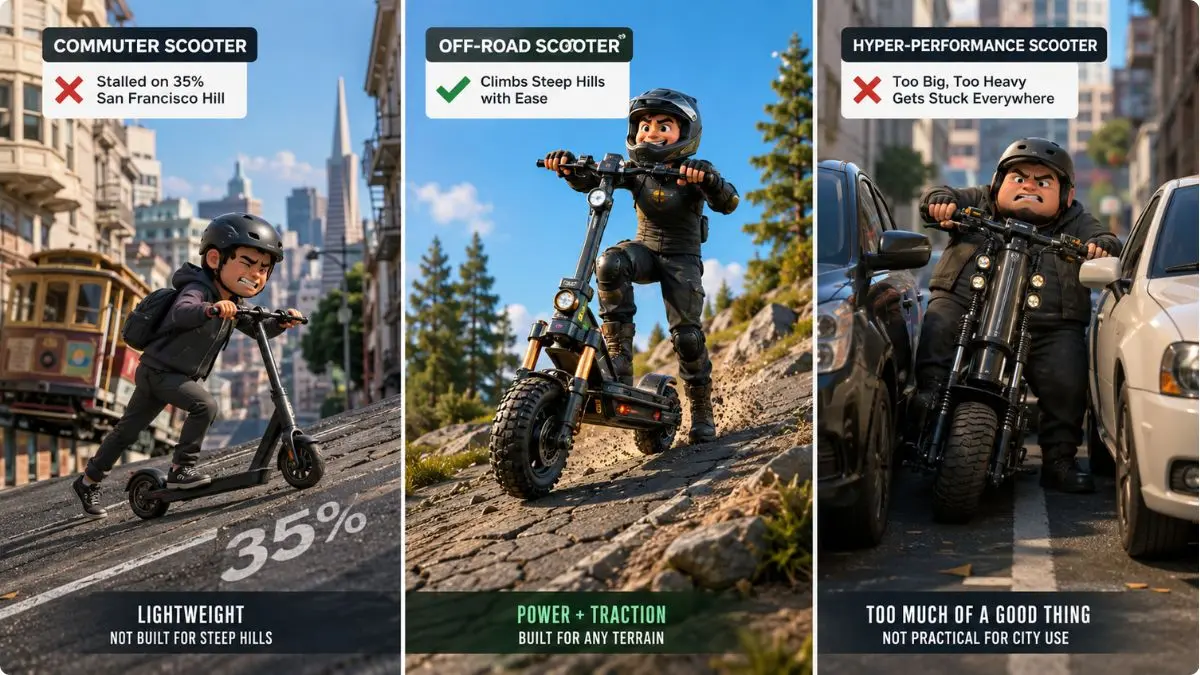
If you are researching Off-Road Scooters, today’s electric scooter market will definitely surprise you. Taking a close look at the industry, you’ll notice two very distinct extremes:
On one end, you have Commuter Scooters — the go-to solution for flat city streets, light commuting, and short daily trips. On the other end are Performance Scooters — heavy-duty speed machines built strictly for adrenaline junkies, track racing, and extreme sport enthusiasts.
However, real-world daily riding is rarely as smooth as theory suggests.
In reality, you face brutal 30% to 40% inclines (or even steeper) in hilly cities like San Francisco or Seattle. You encounter uneven curb cutouts, high speed bumps, cracked pavement, and loose gravel trails during weekend getaway trips.
That is precisely where the gap between these two categories becomes glaringly obvious:
• Commuter Scooters start to choke: Their single motors strain with a loud whine, slow down to a crawl, and stall out mid-hill, with constant risks of voltage drops or fried controllers due to thermal overload.
• Performance Scooters are pure overkill: They are bulky, incredibly heavy, difficult to haul around, and packed with way more power than you actually need for practical daily riding.
As we covered in our comprehensive breakdown on How to Choose an Electric Scooter, this exact dilemma gave birth to Off-Road Scooters (All-Terrain & Hill Climbers). This segment represents the “sweet spot” engineered specifically to conquer steep hills and rough terrain while maintaining practical portability.
So, for a purpose-built category like this, what key specs should a standard Off-Road Scooter actually feature? How do manufacturers strike the perfect balance between mechanical engineering, powertrain efficiency, and portability under the deck?
Let’s break down the core engineering solutions that make up this versatile segment with Ecovura below.
Unpacking Technical Specs Based on All-Terrain Objectives
⚠️ A Note on Ecovura’s Classification Philosophy:
At Ecovura, we believe a smart classification system must be centered around the rider’s real-world intended use, rather than strictly locking a scooter into arbitrary spec boundaries. Classification is always relative.
An Off-Road Scooter doesn’t strictly have to cap out at 3000W peak power or a 48V–52V battery system. Plenty of models on the market feature motors exceeding 4000W peak or premium 60V setups. However, if their overall chassis design, gear ratios, and suspension geometry are optimized for hill climbing and rough terrain rather than flat-out street racing, Ecovura still classifies them under Group 3: Off-Road Scooters. The ultimate question is always: What specific job is this scooter built to do for your ride?
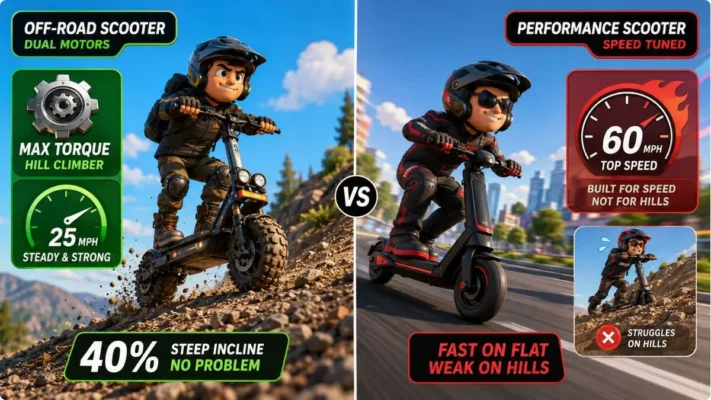
Motors & Power output: “Hill-Climbing Torque” is a Whole Different Game Than “Top Speed”
• Real-World Objective:
Conquering 30% to 40% inclines or blasting through loose gravel requires a machine that generates maximum low-end torque. What riders need here is relentless, steady pulling power so the scooter keeps climbing without throttle lag, power sags, or thermal controller shutoffs halfway up the hill.
• Engineering Solutions from Manufacturers:
o Dual-Motor Configuration: To deliver instant, all-wheel traction, dual motors (front and rear) are practically mandatory. Total nominal power typically ranges from 700W to 1500W, pushing out peak power between 1400W and 3000W (with heavy-duty models reaching 4000W+ on 60V platforms).
o Common Voltage Systems (48V–52V, up to 60V): These provide high discharge rates to sustain heavy torque output without destroying long-term battery health.
o The “Torque Over Top Speed” Tuning Philosophy: This is where many buyers get confused. Motors in Off-Road Scooters are gear-tuned and programmed to prioritize raw torque over top speed. A scooter in this class might boast 3000W peak power yet cap its top speed at a sensible 25 to 35 mph. All that extra energy is funneled directly into the wheels to crush monster hills, rather than chasing 50 to 60 mph top speeds like Performance Scooters.
• The Downside:
To keep price points accessible, many scooters in this category still rely on square-wave or basic sine-wave controllers. When riding slowly on flat pavement or through crowds, you might notice a slightly jerky throttle response from a dead stop. Furthermore, constantly demanding max torque on steep climbs generates significant motor heat, requiring riders to modulate the throttle wisely to avoid triggering thermal safety cutoffs.
Tires & Traction: Solving the “Loose Silt & Gravel Slip” Problem
• Real-World Objective:
When descending gravel-covered hills, riding over rain-slicked asphalt, or hitting dirt trails, a rider’s biggest nightmare is a front-wheel washout. No matter how powerful your motor is, it becomes useless if your tires can’t bite into the ground to transfer torque and hold a line through corners.
• Engineering Solutions from Manufacturers:
o Standard Tire Size & Profile: Most Off-Road Scooters come equipped with large 10-inch to 11-inch pneumatic tires featuring extra-wide tread profiles (usually 3.0 inches or wider) to maximize the ground contact patch.
o Knobby Off-Road Tires: Engineered with raised, deep-tread rubber blocks. These knobs act like tiny anchors, digging deep into soft soil, mud, sand, and loose gravel to provide mechanical grip that slick street tires simply cannot match.
o Wide Pneumatic Tubeless Tires (Self-Sealing): Ideal for hybrid On/Off-Road riding (All-Terrain). Tubeless designs infused with internal tire sealant handle impacts better, drastically reducing the risk of pinch flats out in the backcountry.
• The Downside:
No tire is perfect for every surface. If you run dedicated knobby tires on smooth city asphalt, those rubber blocks will produce a loud humming noise and minor vibrations up the handlebar. More importantly, knobby tires reduce the actual rubber surface touching dry pavement, increasing braking distances and draining battery life up to 15% faster due to higher rolling resistance.
Suspension & Chassis: Soaking Up Shocks & Taking Heavy Impacts
• Real-World Objective:
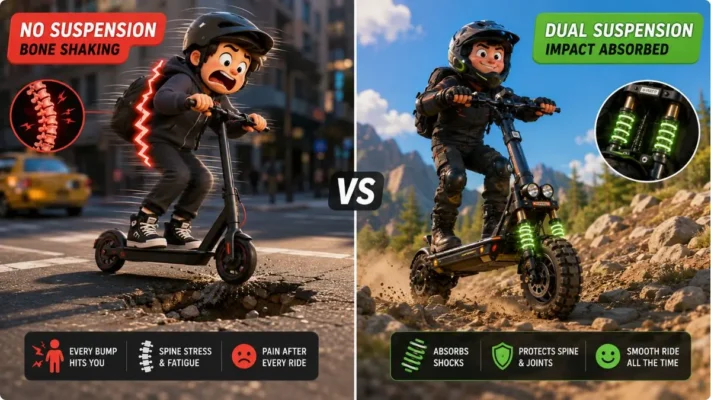
Blasting over gravel, potholes, and exposed tree roots delivers constant high-impact forces back into the scooter. The suspension and chassis serve two vital purposes: protecting the rider’s spine and wrists from fatigue and injury, while safeguarding sensitive electronics (battery pack, wiring, controller) inside the deck from shaking loose or cracking.
• Engineering Solutions from Manufacturers:
o Heavy-Duty Aluminum Alloy Frames: Frames are typically forged from aircraft-grade 6061-T6 aluminum with reinforced folding stem mechanisms. This construction allows the frame to handle massive flexing and twisting forces when landing off curbs or hitting trail obstacles.
o Dual Suspension Systems: Unlike commuter scooters that rely on single springs or no suspension at all, Off-Road Scooters demand dual suspension front and rear. Manufacturers combine dual spring coils, C-type swingarms, or mid-tier hydraulic shocks to absorb rapid compression impacts and keep the tires glued to the trail.
• The Downside:
To keep price points reasonable, spring suspensions in this segment usually lack advanced adjustment valves like rebound or compression damping found on high-end Performance Scooters. After repeated trips through mud, dirt, and grit, protective rubber seals can trap debris, causing springs to develop an annoying squeaking noise if you don’t clean and lubricate them regularly.
Braking Systems: Safe Hill Descents & Eliminating Heat Fade
• Real-World Objective:
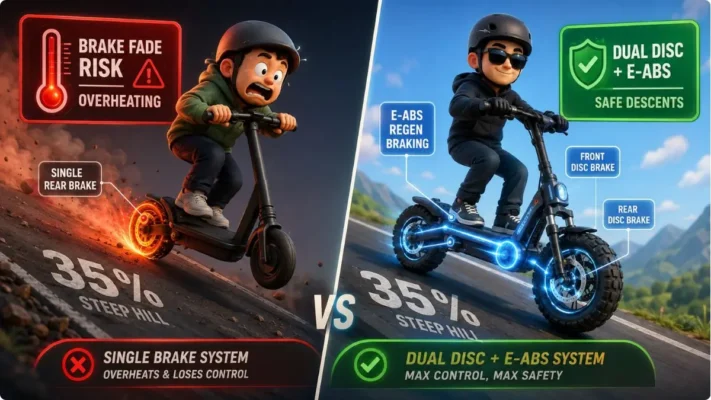
If climbing hills requires motor torque, descending steep 30% to 40% grades at 30 to 35 mph places the entire safety burden on your brakes. Riding down long inclines forces you to feather the brakes continuously. This intense friction creates massive thermal buildup; if your braking system is sub-par, pads and rotors will overheat, leading to sudden brake fade — the most dangerous scenario on an off-road scooter.
• Engineering Solutions from Manufacturers:
o Dual Disc Brake Setup: Heavy-duty 140mm to 160mm heat-vented steel rotors on both wheels are mandatory for Off-Road Scooters. Depending on the price point, brands use mechanical cable-actuated disc brakes or semi-hydraulic disc calipers.
o Electronic Regenerative Braking (E-ABS): The ultimate assistant to mechanical brakes. As soon as you tap the brake lever, the electric motors reverse polarity to apply instant counter-resistance, slowing the scooter down internally before the mechanical pads even clamp the rotor. This significantly reduces rotor heat buildup while recovering energy to trickle-charge the battery.
• The Downside:
To keep prices under $1,400, most models in this segment rely on mechanical or semi-hydraulic calipers rather than full hydraulic systems. Mechanical brake cables stretch over time, and pads wear down quickly after repeated steep hill descents. Riders must manually adjust brake lever slack and pad clearance every few weeks using an Allen wrench. Neglecting this maintenance means your brake levers will pull all the way to the grip while the scooter continues to roll downhill.
Product Spotlight & Competitive Analysis
To highlight the diversity within the Off-Road Scooter category, let’s compare three standout models. Each is engineered to solve a specific riding objective with clear competitive advantages over rivals in its price class.
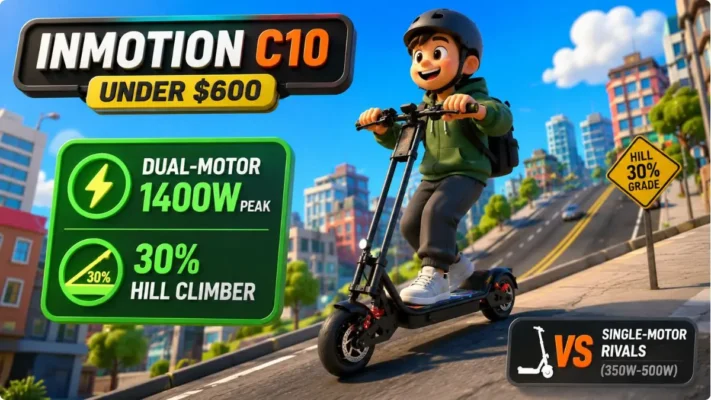
InMotion C10: Democratizing Dual-Motors Under $600
• Intended Use: Built for riders living in moderately hilly urban areas who need dual-motor traction for daily climbs while keeping their budget as tight as possible.
• Key Specs:
o Dual Motors (1400W Peak Power).
o Top Speed: 25 mph.
o Hill Climbing Grade: 30% Incline.
o Braking: Front & Rear Dual Disc Brakes + E-ABS.
o Ultra-Lightweight: Just 47 lbs.
• Competitive Edge Over Rivals ($500–$600 Range):
Under $600, almost every competitor on the market (like the Segway Ninebot E-series or entry Xiaomi models) offers weak 350W–500W single motors with a single rear brake. The InMotion C10 completely disrupts this tier by delivering true dual-motor power and dual disc brakes at an entry-level price point. It stands as one of the few budget options capable of pulling you up urban hills without bogging down.
InMotion Climber: The “Urban Hill-Climbing King” Under $1,000
• Intended Use: Designed specifically for daily commuters in notoriously hilly cities (like San Francisco or Seattle) who need a hill-crushing, ultra-durable workhorse that requires virtually zero maintenance.
• Key Specs:
o Dual Motors: 750W x 2 (1500W Total Peak Power).
o Top Speed: 23.7 mph.
o Max Climbing Grade: 36% Incline (even carrying riders up to 286 lbs / 130 kg).
o Tires: 10-inch Heavy-Duty Self-Sealing Pneumatic Tires.
o Water Resistance: IPX6 for the body and IPX7 for the battery pack.
• Competitive Edge Over Rivals ($900–$1,000 Range):
While competitors chase raw top speed numbers, the InMotion Climber focuses 100% of its engineering on pure climbing torque and bulletproof reliability. Though its top speed is capped at a safe 23.7 mph, its 36% incline capability dominates the sub-$1,000 category — out-climbing scooters that cost twice as much. Ditching complex suspension springs in favor of an ultra-stiff aircraft aluminum frame and military-grade IPX6/IPX7 waterproofing makes the Climber virtually indestructible against rain and heavy daily abuse.
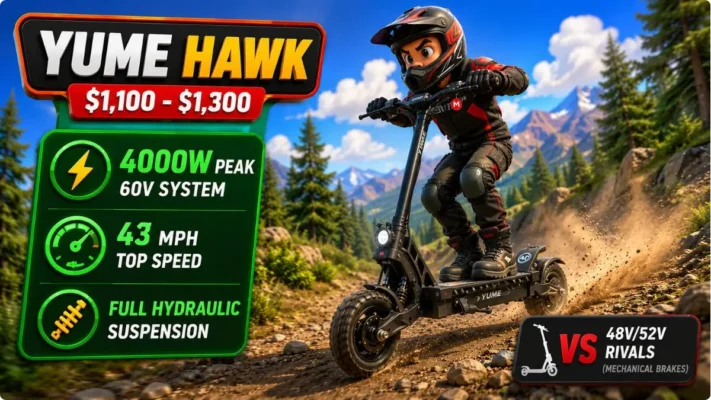
YUME Hawk: True Off-Road & Backcountry Performance ($1,100–$1,300)
• Intended Use: For thrill-seekers looking to tackle real off-road trails: dirt paths, gravel tracks, forest routes, and high-speed pavement carving.
• Key Specs:
o Massive Dual Motors: 1200W x 2 (4000W Total Peak Power).
o Impressive Top Speed: 43 mph on a 60V 22.5Ah battery platform.
o Suspension: Front & Rear Long-Travel Hydraulic Shocks.
o Braking: Full Hydraulic Disc Brakes with 160mm vented rotors.
o Tires: 10-inch Extra-Wide Off-Road Knobby or Tubeless Street Tires.
• Competitive Edge Over Rivals ($1,100–$1,300 Range):
The YUME Hawk redefines mid-tier off-road capability. While competitors in this bracket settle for 48V/52V systems and mechanical brakes, the Hawk brings a high-voltage 60V platform, full hydraulic brakes, and smooth hydraulic suspension. Its 4000W peak power crushes steep off-road inclines effortlessly while floating over rocky trails. It is the closest thing to a full-fledged Performance Scooter without the $2,000+ price tag.
Real-World Perspective: Reddit Community Feedback & Ecovura’s Take
No matter how impressive a scooter’s spec sheet looks on paper, real-world feedback from actual owners—especially on Reddit’s r/ElectricScooters community—serves as the ultimate benchmark for day-to-day value.
A. What Real Owners on Reddit Say About Off-Road Scooters
Based on synthesized feedback from real owners of the InMotion Climber, InMotion C10, and YUME Hawk, here are the most honest pros and cons from the field:
👍 What Riders ABSOLUTELY LOVE:
• Effortless Hill-Climbing Power: The feeling of feathering the throttle and watching the scooter glide up a 30% incline without dropping speed or losing voltage is the single most praised experience. InMotion Climber owners routinely highlight how their scooters eat steep city hills for breakfast—inclines that completely stalled out their previous single-motor commuters.
• Confidence on Rough Terrain: Wide tires combined with dual suspension (or reinforced aluminum decks) allow riders to roll over speed bumps, potholes, cracks, and gravel paths without feeling unstable or losing control of the handlebars.
• Unbeatable Price-to-Performance Ratio: Compared to dropping $2,000 to $3,000+ on massive hyper-scooters, this category delivers roughly 80% of real-world hill-climbing power at a fraction of the cost.
👎 What Owners COMPLAIN ABOUT & WARN:
• Weight Begins to Creep Up: Ranging from 47 lbs (InMotion C10) to 55–64 lbs (InMotion Climber) and reaching up to 77 lbs (YUME Hawk), owners warn that carrying these machines up three or four flights of apartment stairs daily quickly turns into a grueling workout.
• Higher Maintenance Requirements: Continuously pushing a scooter up steep inclines and over rough ground means you will need to check tire pressure, tighten folding stem latches, and manually adjust mechanical brake cable slack far more often than on light city commuters.
B. Core Takeaways & Recommendations from Ecovura (Our Take)
To help you make the smartest buying decision, the review team at Ecovura outlines three golden rules when choosing an Off-Road Scooter:
• 1. Weigh Portability vs. Storage Realities:
The 47 to 64 lbs weight bracket is the absolute “sweet spot” for folding your scooter into a car trunk (sedan or SUV) for weekend adventures or rolling it into an elevator. However, if your home LACKS an elevator and you must haul your scooter up three or more flights of stairs daily, think twice or get ready for an involuntary strength-training routine!
• 2. Match Your Tires to 80% of Your Daily Riding:
Many beginners make the mistake of buying aggressive off-road knobby tires simply because they look tough. Our advice at Ecovura: If 80% of your riding happens on paved city streets (even steep ones), stick with wide pneumatic street tires. Knobby treads only shine on loose dirt, sand, and gravel. Choosing the right tread pattern saves up to 15% of your battery life and eliminates annoying tire hum during daily commutes.
• 3. The “Vital” Wheel Maintenance Rule:
Because dual-motor torque is so aggressive, hitting curb lips or deep potholes puts extreme impact stress on your wheel rims. Always check your tire pressure weekly to ensure it matches the manufacturer’s recommended PSI. Riding on under-inflated tires over rough terrain will smash the metal rim lip straight into pavement or rocks, causing pinch flats, torn inner tubes, or cracked rims instantly!
Conclusion: Off-Road Scooters — The Sweet Spot for Every Terrain
Looking at the big picture, Off-Road Scooters (All-Terrain & Hill Climbers) are far more than just a middle-ground option between lightweight commuters and hyper-speed machines. They represent a smart, purpose-driven design philosophy built specifically for real-world riding.
By channeling engineering efforts into low-end dual-motor torque, wide-tread traction, and reinforced chassis durability, this category completely solves the headache of 30% to 40% steep hills and unpaved gravel paths. It conquers the terrain where lightweight commuters give up, while saving you from paying for an overly bulky, overpriced $3,000 performance scooter.
Whether you prioritize maximum affordability with the InMotion C10, bulletproof urban hill-climbing durability with the InMotion Climber, or backcountry trail performance with the YUME Hawk, the ultimate goal is understanding your personal riding needs.
The best scooter isn’t necessarily the most expensive or the fastest model on the market—it’s the one that fits your daily route, terrain, and storage reality perfectly. Pick the right setup, maintain your gear, and enjoy the ride with Ecovura!