
Introduction
The personal electric transportation landscape has shifted dramatically. Electric scooters are no longer just lightweight, last-mile gadgets built for flat sidewalks or quick grocery runs. A new breed of heavy-duty machines has officially taken over the tarmac. As we previously classified in our ultimate 2026 electric scooter buyer’s guide, these elite units belong to the most powerful tier on the market: Performance Beasts — The Hardcore Enthusiast.
These vehicles are engineered to go head-to-head with public transit, gas mopeds, and even cars in dense urban environments. Built for extreme top speeds, breathtaking acceleration, and rugged structural durability, this segment caters directly to speed junkies, thrill-seekers, and long-range commuters across the US and Europe. But with price tags ranging from $1,500 to well over $4,000, what kind of cutting-edge technology are you actually paying for under the deck—and what real-world limitations are hidden behind the marketing hype? Let’s dissect a true high performance electric scooter under a completely objective lens.
The Core Anatomy & Modern Tech of Performance Beasts — The Hardcore Enthusiast
⚠️ Important Note Before Diving In: This section highlights the most groundbreaking technological advancements in the high performance electric scooter market today. However, please note that not every model will feature all of these premium technologies. Depending on the price tier and manufacturing philosophy, each scooter implements a different combination of features. In our upcoming, in-depth product reviews, we will thoroughly analyze the exact real-world configuration of each specific machine.
Dual Motors, Extreme Voltage & Smart Controller Tech
At the absolute heart of every hyper-tier high performance electric scooter sits a dual-motor configuration delivering a combined peak output from 3,000W to 8,000W+. To back up this immense wattage, these machines require a massive electrical backbone—typically a 60V or 72V electrical system engineered with exceptionally high discharge rates. This combination allows heavy-duty riders to easily unlock speeds between 40 to 60+ mph (64 – 96+ km/h) and rocket up brutal 35% urban inclines (around 19 degrees) without losing a single watt of momentum.
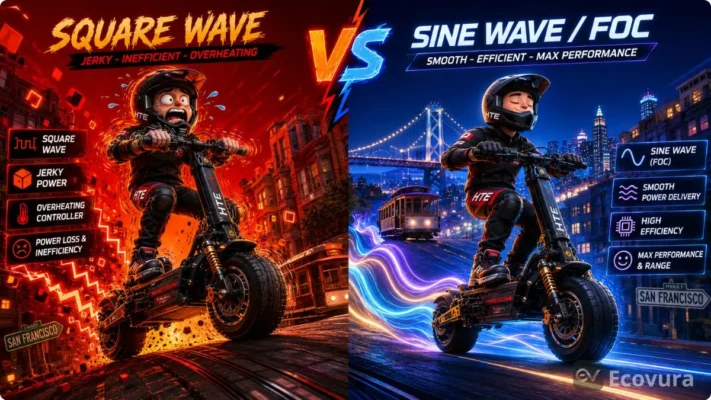
The fiercest technological battlefield today centers around Controller Technology, aiming to replace the jerky, aggressive throttle delivery of older Square Wave Controllers with advanced Sine Wave Controllers paired with FOC (Field Oriented Control). This setup provides micro-precise torque management, buttery-smooth acceleration from a dead stop, and whisper-quiet motor operation.
• The Thermal Management Challenge: When the discharge rate reaches 40A to 50A under heavy loads, the controllers generate massive amounts of heat. Premium scooters must be designed with heavy-duty cast aluminum heatsinks wrapping around the controllers, paired with specialized thermal paste or pads to dissipate heat directly into the scooter’s metal frame. Poor thermal dissipation triggers thermal throttling (a sudden drop in power output) or, in worse cases, completely melts the motor phase wire connectors.
• The Real Downside: While Sine Wave controllers offer unmatched riding refinement, they introduce a slight, inherent throttle lag right at the initial pull. Hardcore riders who crave an aggressive, instant wheel-spinning kick from the very first millisecond might find it a bit too “tame” compared to traditional square wave systems.
Traction Control & Torque Vectoring
As motor outputs cross the 5,000W threshold, wheel slip becomes a serious safety hazard. Advanced Traction Control Systems (TCS) solve this by monitoring wheel slip in real-time to automatically redistribute power between the front and rear motors when riding on wet asphalt, loose gravel, or during hard cornering. While some cutting-edge models have begun implementing electronic power distribution between the front and rear hubs, true, comprehensive Torque Vectoring—as seen on high-end electric sports cars—has not yet become a mainstream standard in the electric scooter industry.
• The Real Downside: Algorithmic software control can sometimes respond too mechanically. When riding through deep sand or mud—where a wheel actually needs to spin aggressively to break free—the TCS can misread the telemetry, automatically cut motor power, and cause the scooter to lose momentum and get stuck.
Smart BMS & Next-Gen Energy Cells
An elite high performance electric scooter is only as good as its fuel tank. This segment utilizes premium, high-density, high-discharge lithium cells—most notably Samsung 50S or Molicel P42A/P45B cells in the 21700 format—to maximize power delivery and minimize battery sag (the performance drop that occurs as the battery discharges).
Protecting this expensive power pack is a Smart BMS (Battery Management System) that manages cell balancing, monitors temperatures at multiple critical points within the battery pack, and provides real-time battery health data through a Bluetooth-connected smartphone app.
• The Real Downside: Cost is the single biggest barrier. A battery pack equipped with premium cells and a Smart BMS is incredibly expensive, often accounting for 40% to 50% of the entire scooter’s retail value. Furthermore, high-discharge cells will naturally degrade and lose capacity faster than standard commuter batteries if they are constantly pushed to their absolute drainage limits during high-speed rides.
Motorsport-Grade Braking Systems
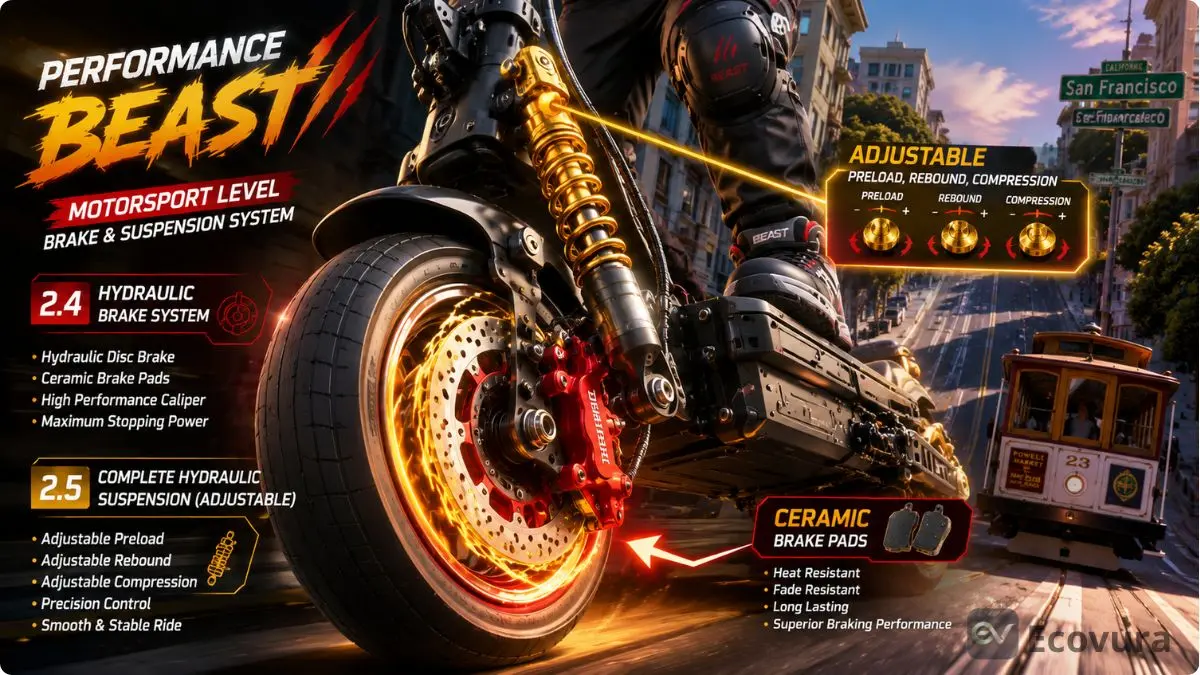
Sustained high speeds demand a high-performance braking solution, making Full-hydraulic disc brakes on both wheels an absolute industry standard in this tier.
• Technical Details: High-performance models typically sport thick brake rotors with diameters ranging from 140mm to 160mm to increase stopping power and maximize heat dissipation. Depending on the intended use case, manufacturers equip these systems with Semi-Metallic, Sintered Metal, or Ceramic Brake Pads. Each type offers distinct trade-offs in terms of overall lifespan, braking bite, thermal tolerance, and operating noise.
To prevent brake fade (the dangerous drop in stopping efficiency as temperatures skyrocket during heavy, repeated braking), modern setups combine mechanical hydraulics with Regenerative Braking (E-Braking). This technology uses the electric motors to help slow down the vehicle, reducing the thermal load on the physical rotors and pads while capturing a small percentage of energy to pump back into the battery.
• The Real Downside: Hydraulic brake systems require intensive and complex maintenance. Owners must regularly bleed the lines to remove air bubbles, change the brake fluid periodically, and monitor the calipers for oil leaks. Furthermore, if high-end ceramic pads have not reached their optimal operating temperature, they can emit a loud, high-pitched squeal that is highly annoying during low-speed city riding.
Adjustable Hydraulic Suspension & Steering Dampers
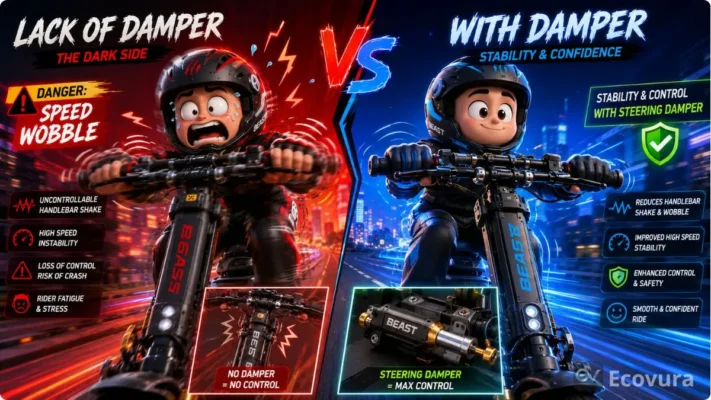
The standard for premium ride comfort relies heavily on Adjustable Hydraulic Suspension systems, allowing riders to fine-tune their mechanical shock absorption via three primary metrics: Preload (spring tension), Rebound (extension speed), and Premium Compression (damping stiffness). Additionally, to neutralize the terrifying phenomenon known as speed wobble at speeds above 35 mph, a hydraulic Steering Damper is is strongly recommended in this tier.
• The Real Downside: Manual adjustable suspension setups are highly complex for beginners. Without proper knowledge, tuning them incorrectly can ruin the ride experience—making the scooter either painfully stiff for your lower back or dangerously bouncy during cornering. Over time, riding hard through rough terrain can wear out the rubber seals, leading to oil leaks that require a complicated rebuild or replacement.
Real Weatherproofing Standards (IP65/IP66)
Manufacturers are actively upgrading hyper scooters to true IP65 and IP66 weatherproofing ratings, sealing the controller bay, integrating waterproof dashboard displays, and utilizing marine-grade wiring harnesses.
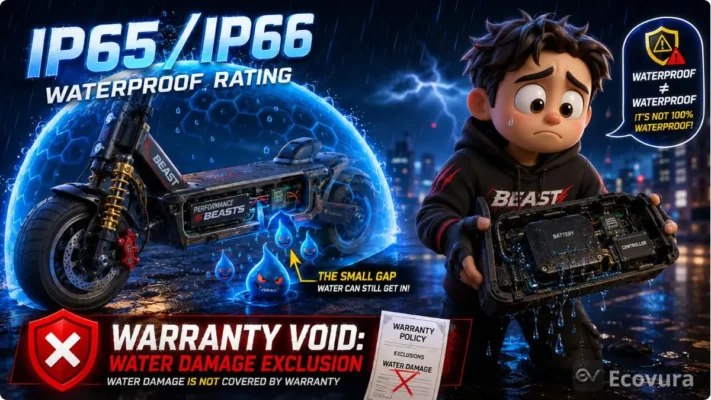
• The Real Downside: This is often a massive marketing trap. Despite boasting high IP ratings, almost 100% of electric scooter brands explicitly exclude water damage from their standard warranty (Water damage exclusion). Furthermore, the internal waterproof rubber gaskets and seals will naturally degrade and shrink over time due to weather exposure, causing the vehicle’s water resistance to decline significantly after just a few months of real-world use.

Aviation-Grade Frames & Wide Tubeless Tires
To withstand extreme physical stress, frames are engineered from ultra-strong aviation-grade aluminum alloys (typically 6061-T6 or 7075-T6), rolling on massive 10-inch to 11-inch wide profiles—either Ultra-wide Tubeless Street Tires filled with anti-puncture tire slime or aggressive Knobby Off-Road Tires.
• The Real Downside: The extreme rigidity of an aviation-grade aluminum chassis significantly reduces the frame’s natural flex, meaning every single ounce of road vibration is transferred directly to the suspension components. For wide tubeless tires, the massive contact patch creates high rolling resistance, which drains the battery faster. Most notably, attempting to remove a wheel that houses a heavy hub motor to fix a flat tire at home is a absolute mechanical nightmare without specialized workshop tools.
Connected Ecosystems & Digital Security
Modern security features include NFC card locking, Biometric Fingerprint Scanners, smartphone app integrations via Bluetooth, real-time GPS anti-theft tracking, and over-the-air (OTA) firmware updates.
• The Real Downside: Over-engineering a vehicle with smart electronics introduces more points of failure. If the companion app suffers a connection glitch, or the NFC module errors out while you are out on a ride, your $3,000 high-tech machine will instantly turn into an immovable, heavy paperweight.
Which Technologies are Worth the Money?
| Technology | Is It Worth the Money? |
| Dual Motor | Mandatory |
| Smart BMS | Highly Recommended |
| Hydraulic Brakes | Mandatory |
| Steering Damper | Highly Recommended |
| GPS Tracking | Optional |
| NFC Unlock | Optional |
Speed vs. Safety: The Crucial Trade-off
Riding an electric vehicle at 50+ mph delivers an unparalleled rush of adrenaline, but it demands absolute respect.
• Mandatory Safety Gear: Standard bicycle helmets are completely useless at these speeds. Operating a hyper scooter requires full motorsport-grade gear: a certified full-face motorcycle helmet (DOT or ECE rated), armored motorcycle gloves, and rigid knee/elbow guards.
• Throttle Modulation: With thousands of watts available instantly, mastering subtle throttle inputs and understanding how your weight shifts during hard acceleration or panic braking is vital to keeping the rubber side down.
Key Factors to Consider Before Buying a Heavyweight Scooter
• Weight & Portability: These machines are heavy, scaling between 70 to 120+ lbs (32 to 55+ kg). They cannot be easily carried up apartment stairs or tucked under a subway seat. Ensure you have ground-floor storage or a vehicle with a large trunk space (like an SUV or truck bed).
• Local Regulations & Laws: High-performance scooters occupy a legal gray area in many regions. Micro-mobility laws vary wildly by state in the US and country in Europe regarding maximum legal speeds and whether these machines are banned from public bike lanes.
Sneak Peek: Finding Your Ultimate Ride
In the coming weeks, we are launching a series of comprehensive, real-world reviews focusing on the top high-performance electric scooters in the market. Since value-for-money hyper-scooters are highly requested by our community, we are kicking off our in-depth testing with the complete flagship lineup from YUME:
YUME Raptor 2: Our top pick for the best budget hyper-scooter. It pairs motorsport-grade dual hydraulic suspension with a beastly dual-motor setup that rides like a much more expensive machine.
YUME X11 : The legendary “beast” built for raw off-road dominance and extreme top speeds. Our teardown and field testing results are coming soon.
YUME Hawk: A sleek, agile daily commuter designed for street racing enthusiasts who need a perfect balance of weight, speed, and maneuverability.
Stay tuned as we update these links with real-world performance data, exact range tests, and build-quality breakdowns for each model!
Future Horizon: What’s Next for Hyper Scooters?
As we look toward the late 2020s, the next generation of high-performance electric scooters is currently in its very infancy stages regarding micro-mobility development:
1. Radar + AI Safety Sensors: Onboard depth sensors and computer-vision AI cameras to map road surfaces and detect potholes or blind-spot traffic in real-time.
2. Adaptive Electronic Suspension: Shocks that automatically alter their compression and rebound stiffness within milliseconds based on travel speeds and live road vibrations.
3. Silicon Carbide (SiC) Controllers: Advanced semiconductor technology migrating from full-sized electric vehicles to maximize battery conversion efficiency and almost completely eliminate thermal energy losses.
Conclusion
Investing in a vehicle from the Performance Beasts — The Hardcore Enthusiast segment is an investment in cutting-edge mechanical engineering, elite software management, and pure freedom of movement. By thoroughly understanding both the immense performance benefits and the inherent downsides beneath the deck, you can confidently choose a machine that safely, practically, and reliably satisfies your hunger for speed.