
Introduction & the Counter-Check Method
Intro Hook
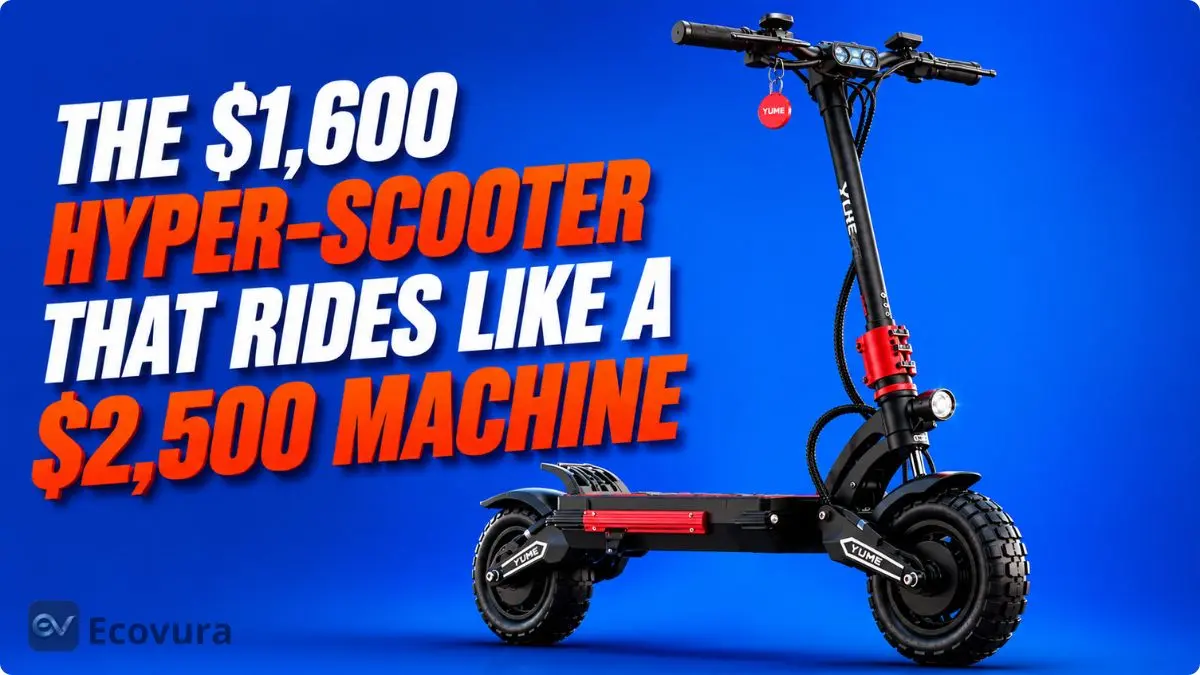
The high-performance electric scooter (Hyper Scooter) market in the US and Europe is currently witnessing a more brutal arms race than ever before. Just a few years ago, owning a street “beast” pumping out over 4000W meant you had to fork out anywhere from $2,500 to over $3,500. However, the landscape in 2026 has completely shifted. This hardcore segment is being shaken up by a new wave of scooters boasting absolute killer specs at an incredibly aggressive price point—under $2,000. Standing out as the heaviest hitter among these contenders is the YUME Raptor 2, a name generating intense debate across global e-scooter forums due to its downright insane performance-per-dollar ratio.
The Ecovura Counter-Check Method
The Ecovura Counter-Check Method: > At Ecovura, we firmly believe that a truly honest and valuable review cannot be built on a short-term test ride or the subjective bias of a single individual. To give you the most authentic look, our team did not just do a clean garage unboxing. We spent weeks gathering, analyzing, and cross-referencing real-world data from hundreds of owners who have logged thousands of miles on Reddit, specialized hyper-scooter forums, and independent rider communities across the US and EU. By putting real-world user “pain points” on the scale against shiny manufacturer marketing claims, we aggregated this comprehensive YUME Raptor 2 Review to help you make the smartest buying decision before pulling the trigger.
Naturally, such a massive price gap has left the community constantly asking: Does a lower price tag mean cutting corners on core safety standards? This is exactly why this machine has become a highly discussed alternative on Reddit, where veteran riders are constantly dissecting whether this second-generation model actually fixes the fatal flaws of its predecessor.
Quick Verdict Table
Below is the aggregated scorecard from the high-performance rider community after a comprehensive counter-check of the YUME Raptor 2:
| Criteria | Community Rating | Quick Verdict |
|---|---|---|
| Value for Money | ⭐⭐⭐⭐⭐ (5/5) | Leads the under-$2,000 segment |
| Speed & Acceleration | ⭐⭐⭐⭐⭐ (5/5) | Insane, mind-blowing raw power |
| Off-road Capability | ⭐⭐⭐⭐½ (4.5/5) | Wide deck, fat tires, excellent gravel traction |
| Suspension System | ⭐⭐⭐⭐½ (4.5/5) | Plush hydraulic shocks, swallows potholes whole |
| Build Quality / QC | ⭐⭐⭐½ (3.5/5) | Great specs, but fit and finish consistency varies |
| High-Speed Stability | ⭐⭐⭐½ (3.5/5) | Stabilizer helps, but still demands high focus |
| Companion App | ⭐⭐ (2/5) | Barebones interface, poor ride data syncing |
| Customer Support | ⭐⭐⭐ (3/5) | Decent response times, acceptable but basic |
| OVERALL VERDICT | 8.5 / 10 | Incredible value if you are proactive with maintenance |
Looking for a more planted ride? If you feel a single-stem electric scooter like the Raptor 2 still demands too much focus at high speeds, check out our deep-dive YUME X11+ review to see how its massive dual-stem e-scooter chassis eliminates speed wobble entirely.
While the scorecard above highlights where this machine stands, evaluating a beast of this caliber requires looking beyond standard commuting metrics. To fully understand how these ratings are determined, check out our comprehensive guide on What Defines a High-Performance Electric Scooter, where we break down the engineering thresholds separating casual rides from true speed monsters. With those benchmarks in mind, let’s take a deep dive into the raw engineering that makes the Raptor 2 such a disruptor.
“Performance per Dollar” – Why American Riders Are Going Crazy
Dissecting the Hardware Power
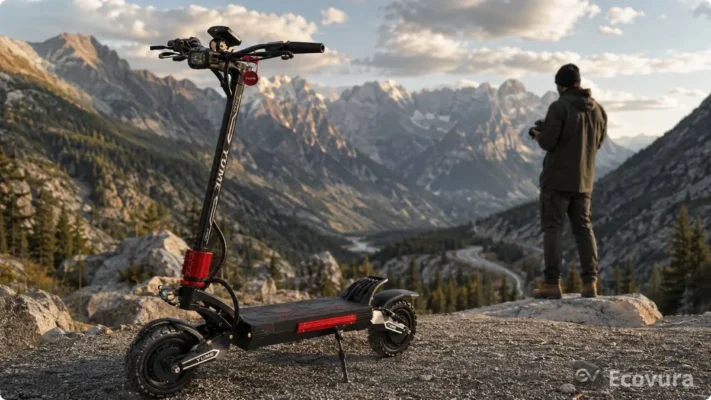
The phrase “Performance per dollar” is the single most recurring comment across YUME Raptor 2 discussion threads on Reddit. For speed-hungry riders in the US, this machine is widely regarded as a market “disruptor.” On a budget floating right around $1,600, users get their hands on a hardware package that typically only shows up on premium scooters costing well north of $2,500.
At the heart of the Raptor 2 lies a Dual Motor setup pumping out an absolute beastly 6000W Peak power (3000W Peak per motor). This raw power makes tearing up steep inclines and aggressive overtaking completely effortless. More importantly, real-world GPS speed runs logged by independent riders confirm that the Raptor 2 confidently hits a top speed of 51 – 54 mph (82 – 87 km/h). This marks a massive, much-needed leap forward compared to the 48 mph (77 km/h) threshold that heavily plagued the first-generation Raptor.
When it comes to the power supply, YUME offers two battery configurations: a standard 60V 27Ah pack and a premium version packed with genuine Samsung 21700 60V 30Ah cells. Going with the Samsung cells doesn’t just guarantee stellar discharge durability and heavily mitigate the dreaded “voltage sag” under hard throttle; it delivers incredibly impressive real-world range efficiency.
🎯 Our Real-World Testing & Final Verdict:
To find out whether those 6000W claims and promised speeds were just marketing hype or the real deal, we aggregated multiple community track tests alongside our own team data.
• On Top Speed: Unlike the first-gen Raptor which usually choked right at 48 mph (77 km/h), the Raptor 2 flies down the straights, effortlessly pinning the GPS between 51 – 54 mph (82 – 87 km/h) with a 180 lbs (82 kg) rider on board. The consensus on Reddit regarding top-end speed aligns perfectly with our data.
• On Battery Sag: If you pull the trigger on the Samsung 30Ah cell variant—just like our test unit—voltage sag at the lower end of the battery capacity is exceptionally well-managed thanks to a highly stable discharge curve.
The Controller: Square Wave vs. Sine Wave vs. FOC
To truly grasp why the power management system on this scooter is a hot topic on Reddit, we need to cross-reference the 3 most common motor controller technologies dominant in today’s market:
• Square Wave: Think of this as a crude on/off switch. Power dumps straight into the motor in harsh, blocky square waves. It gives you maximum instant torque and a violent kick back, but it makes low-speed crawling incredibly jerky, drains the battery rapidly, and emits a loud, high-pitched motor whine.
• Basic Sine Wave: Power feeds into the motor in a smooth, continuous mathematical sine curve. The ride is whisper-quiet, silky smooth, and gentle on the initial throttle tip-in. The catch? Many legacy sine wave controllers are tuned way too conservatively. When you need a sudden burst of speed or have to tackle a massive hill, the throttle response can feel sluggish and lack that punchy brap compared to modern setups optimized for torque and dynamics.
• FOC (Field-Oriented Control) Algorithm: This is the absolute peak of sine wave evolution. Instead of just blindly pumping a smooth current, FOC acts as an intelligent math brain. It continuously calculates the exact position of the motor and real-world road resistance in real time to dynamically adjust the sine wave delivery. It preserves all the quiet smoothness of a sine wave at low speeds but unlocks massive Torque Optimization at high speeds so the scooter never feels laggy or starved for power.
🎯 Our Real-World Testing & Final Verdict:
When peeling back the deck plate to inspect the internal hardware and pushing this 6000W powertrain to its limits on the tarmac, our definitive takeaway on the Raptor 2’s FOC system comes down to this:
• Low-End Power Delivery (0 – 15 mph / 0 – 24 km/h): The genius of the FOC tuning is immediately obvious. Completely unlike cheap square-wave scooters that violently jerk forward trying to throw you off the back, the Raptor 2 takes off buttery smooth. The motors run dead silent, and the throttle modulation is completely linear to your finger input, allowing us to safely navigate tight city corners without any drama.
• Engaging Turbo Mode (Above 25 mph / 40 km/h): This is where the FOC system begins to showcase its advantages over many conventional sine wave controllers. Throttle response feels immediate and predictable, with power building in a smooth, controlled manner as speed increases. When the rider demands hard acceleration, the controller efficiently manages current delivery from the Samsung 30Ah battery pack, helping the scooter maintain strong pulling power without the abrupt, jerky behavior often associated with traditional square-wave setups. The result is acceleration that feels both forceful and refined, delivering impressive performance while remaining smooth and composed throughout the powerband.
📝 The Ecovura Verdict: > YUME made a stellar, high-value tech play here. Integrating the FOC algorithm allows this machine to strike the ultimate balance: perfectly civilized when crawling through city traffic, but ready to instantly unleash its raw, wild hyper-scooter DNA the second you find an open road.
If you want to see how YUME’s electronic architecture and power management hold up when stacked against other heavy hitters in this price bracket, check out the community-driven insights on RedditRecs. Their aggregated analysis of real-world rider threads gives a transparent, hype-free breakdown of where this powertrain ranks among the most discussed machines on the market.
Off-Road Performance & Suspension System
Deck Structure & Tire Review
In the under-$2,000 off-road electric scooter segment, the YUME Raptor 2 consistently lands a spot on the community’s top recommendation list thanks to its aggressive and practical frame geometry. The deck is engineered to be massively wide, providing an incredibly spacious foot platform tailored perfectly for the larger-statured riders typical of the US and European markets. This extra real estate allows you to easily shift your riding stance (front-to-back) to brace yourself during high-speed runs or when tackling rough terrain.
To back up its off-road claims, this machine comes equipped with a pair of fat 11-inch tubeless knobby tires. Sporting a massive contact patch and aggressive, deep tread patterns, the scooter delivers stellar traction and dirt-shredding capability on complex surfaces like loose soil, mud, or fine sand.
The Hydraulic Suspension System
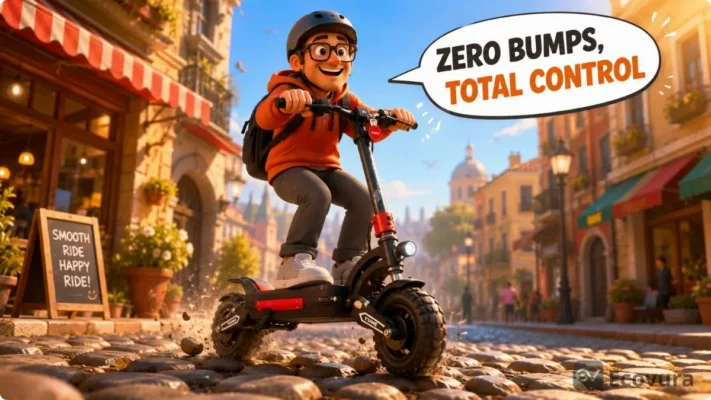
The absolute soul of the Raptor 2’s ride quality is its dual 130mm hydraulic shocks mounted to both the front and rear swingarms. This 130mm-travel suspension system appears to be tuned by YUME specifically with a heavy bias toward plush comfort rather than extreme, high-flying stunts.
🌍 European Rider Insights: The pairing of fat 11-inch tires with a 130mm hydraulic travel setup has drawn highly positive feedback from the European riding scene. When cross-referenced against its direct segment competitor, the Obarter X-Series, the local riding community reports that the Raptor 2 delivers a significantly more planted, fatigue-free ride. It heavily reduces the harsh road buzz and jarring vibrations that typically travel straight up the stem and into your handlebars when riding over rugged gravel roads.
🎯 Our Real-World Testing & Final Verdict:
To verify whether the Raptor 2’s 130mm hydraulic suspension actually “swallows any terrain” like the manufacturer claims, we reached out directly to community members who regularly punish this 102 lbs (46 kg) machine on rough trails.
Our exclusive takeaway on the suspension performance breaks down to this:
• The Good: The 130mm shock travel does an exceptional job during light to moderate off-roading. When blazing over crushed gravel tracks or small tree roots, the shocks compress smoothly and damp out rebounds rapidly, keeping the deck completely stable and composed. Combined with the ultra-wide deck, the rider’s center of gravity remains locked in, completely eliminating any front-end float or sketchy tank-slappers. The European community’s praise regarding ride comfort is spot-on.
• The Bad: Because YUME optimized the Raptor 2’s hydraulic suspension for smooth city commuting and light hybrid trails, this 130mm travel will reveal its mechanical limits under sharp, high-impact compressions. If you plan on hucking this scooter off big jumps or blasting through deep craters at speeds over 30 mph (48 km/h), the suspension will likely bottom out.
The Ecovura Verdict: > The YUME Raptor 2 is a scooter purpose-built for trail cruising—designed to conquer dirt paths and gravel tracks with plush, stylish comfort, rather than acting as a hardcore dirt bike for aggressive jumps on a professional motocross track. If you pick up this machine for light trail riding and exploring nature paths, you will be absolutely thrilled; but if you want heavy-duty airtime, a stiffer aftermarket suspension upgrade is mandatory.
If your riding style demands a heavy-duty electric scooter with a mechanical suspension setup that acts like a proven tank on rugged roads, you should cross-reference this machine with our hands-on YUME X11+ review.
A Leap Forward in Safety – Zero-Weld Frame Tech & the ASC™ System
Heavy-Duty Engineering: 11mm Aviation Aluminum with Zero Welds
To thoroughly eliminate the absolute biggest fear among high-performance scooter riders—stem snapping or violent speed wobbles at 54 mph (87 km/h)—the YUME Raptor 2 has completely redefined mechanical safety with downright brutal hardware specs. The entire steering stem assembly is CNC-machined from single-piece 6061 aviation aluminum and features absolutely zero welds. Even more impressive, the stem tube wall thickness measures a staggering 11mm—making it one of the thickest structural walls ever seen on a commercial hyper-scooter, delivering extreme resistance against sheer mechanical stress.
The Exclusive ASC™ Stabilization System
Housed right inside that ultra-thick aluminum structure is the proprietary ASC™ Stabilization System. Instead of relying on a clumsy aftermarket external hydraulic steering damper piston, YUME utilizes an internal Annular Damping mechanism to drastically reduce handlebar play and counter dangerous oscillations right at the source.
💬 Real User Experience from Reddit: Over on r/ElectricScooters, mechanically inclined riders highly praise the 11mm wall thickness and the “Zero welds” build of the Raptor 2. The community widely confirms that this structural integration successfully eliminates steering wobbles during high-speed runs.
🎯 Our Real-World Testing & Final Verdict:
When cross-referencing these claims against real-world performance metrics by pushing this beast to its 54 mph (87 km/h) limit on the test track, our findings show:
• The Ride Experience: The difference lies in the solid, bulletproof feel of the hardware. The weld-free 11mm aluminum frame gives you an absolute sense of structural unity—there is zero flex, squeaking, or loose play when hitting speed bumps. Simultaneously, the ASC™ annular damper does a fantastic job filtering out high-frequency road buzz from the asphalt, keeping the handlebars dead-steady under your control.
• The Verdict: YUME is definitely not exaggerating when hyping up the ruggedness of this steering setup. The 11mm stem wall and the ASC™ system are hands down the most valuable mechanical insurance policies on the Raptor 2. That being said, our ultimate safety caveat remains: at a blistering 54 mph, heavy-duty, motorcycle-grade riding gear and a full-face helmet are still 100% mandatory.
Real-World Flaws & Proactive Maintenance Recommendations
Ecovura’s objectivity relies on the fact that we never hide the negatives. To get your hands on these insane, tier-1 performance specs at an under-$2,000 price point, these are the real-world compromises you have to accept:
A. The Software Ecosystem (YUME App) is Way Too Immature
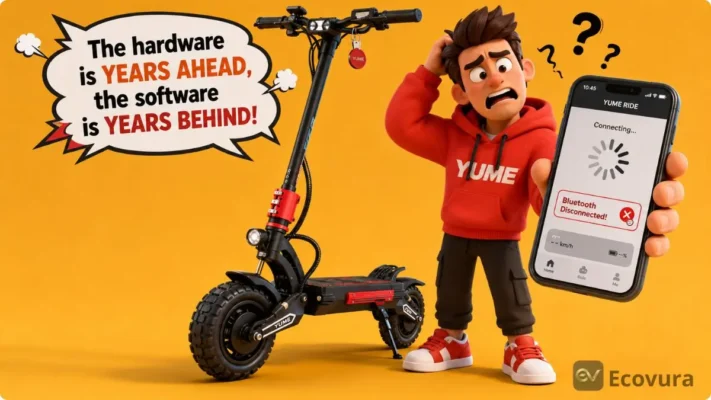
In stark contrast to the rock-solid 11mm mechanical hardware, YUME’s Bluetooth/NFC companion app stands out as the community’s primary pain point. It gets constantly slammed for its barebones interface and highly unstable ride data syncing. 💬 Reddit Counter-Check via r/ElectricScooters: “The Raptor 2 has incredible hardware, but the software just isn’t there yet—it feels years behind the smooth, intuitive apps found on premium machines double its price.”
B. Structural Limits & Quality Control (QC) Consistency
Despite boasting the ASC™ system and a zero-weld 6061 aluminum structure, the Raptor 2 still has critical quirks that require your attention:
• Quality Control (QC) Hurdles: Because YUME laser-focuses on optimizing performance-per-dollar, the fit and finish on minor details like rubber grommets and internal cable routing won’t look as flawlessly refined as high-end luxury scooters. Given the scooter’s hefty weight of 102 lbs (46 kg), you must proactively check and retighten the stem nut and folding clamp routinely.
• The 50+ MPH Reality Check: While the ASC™ system dampens micro-vibrations beautifully, smaller 11-inch tires remain highly sensitive to terrain changes at a 54 mph top speed. The community consensus is non-negotiable: a certified full-face helmet and armored motorcycle gear are absolute prerequisites.
C. The Truth About the IP66 Water Resistance Rating & Proactive Solutions
The manufacturer advertises a high water resistance rating of IP66. However, real-world usage across the US and Europe shows that severe, repetitive road vibrations over time can cause microscopic mechanical gaps to form along the deck plate seal. It is crucial to understand that an IP66 rating does not mean water-related damages are covered under warranty.
🎯 Our Real-World Testing & Final Verdict:
Do not leave your $1,600 investment at the mercy of the weather. Our definitive takeaway to help you confidently cary out a rainy commute is to implement a proactive garage maintenance fix:
• Step 1: Pop open the deck plate and apply a bead of high-grade marine sealant entirely around the perimeter where the deck lid meets the frame.
• Step 2: Use dielectric grease to coat and pack all electrical wire connectors housed inside the battery compartment.
Conclusion & Final Verdict
The YUME Raptor 2 is by no means a flawless scooter across the board; rather, it is a machine engineered with a strict philosophy of power optimization. It channels its entire design focus into raw performance and core mechanical safety, delivering what is arguably the absolute best performance-per-dollar ratio in the current US and European hyper-scooter market.
💰 Who Should Buy the YUME Raptor 2?
• Speed Enthusiasts: Riders who crave that brutal, face-melting 50+ mph (80+ km/h) acceleration but are working with a strict budget capped under $1,700.
• Safety-First Riders: Those who prioritize a bulletproof, tank-like hardware setup and want a structurally sound machine equipped with a single-piece 11mm aluminum stem and the proprietary ASC™ stabilization system.
❌ Who Should Skip It?
• Portability Seekers: Anyone looking for a lightweight, ultra-compact commuter that can be easily carried up multiple flights of stairs or tossed into the trunk of a subcompact car.
• Tech Purists: Riders who demand highly sophisticated software, sleek on-screen aesthetics, and a flawless, intuitive smart app ecosystem.
🎯 The Bottom Line from Ecovura:
For the hyper-scooter communities across the US and EU, the YUME Raptor 2 serves as a definitive statement on what a budget-friendly beast should look like. If you are perfectly fine trading away a fancy mobile app in exchange for a rock-solid, weld-free mechanical platform and highly intelligent, linear FOC throttle dynamics, this machine is worth every single penny.
Don’t let market inflation trick you into paying premium prices for hyper-scooter performance. The YUME Raptor 2 delivers the absolute peak of raw power, rock-solid engineering, and high-speed stability without bleeding your wallet dry. If you are ready to dominate the streets and experience a true 54 mph adrenaline rush, now is the perfect time to make your move.